
Most AI rollouts fail not because the technology doesn't work, but because organizations treat adoption as an IT deployment rather than a change management effort. After studying how large-scale AI implementations succeed, two things become clear: you need a structural roadmap for the rollout itself, and you need to understand the psychology of why people do or don't adopt new tools. Here's a framework that combines both — and it applies just as well to a rural SME as it does to a multinational.
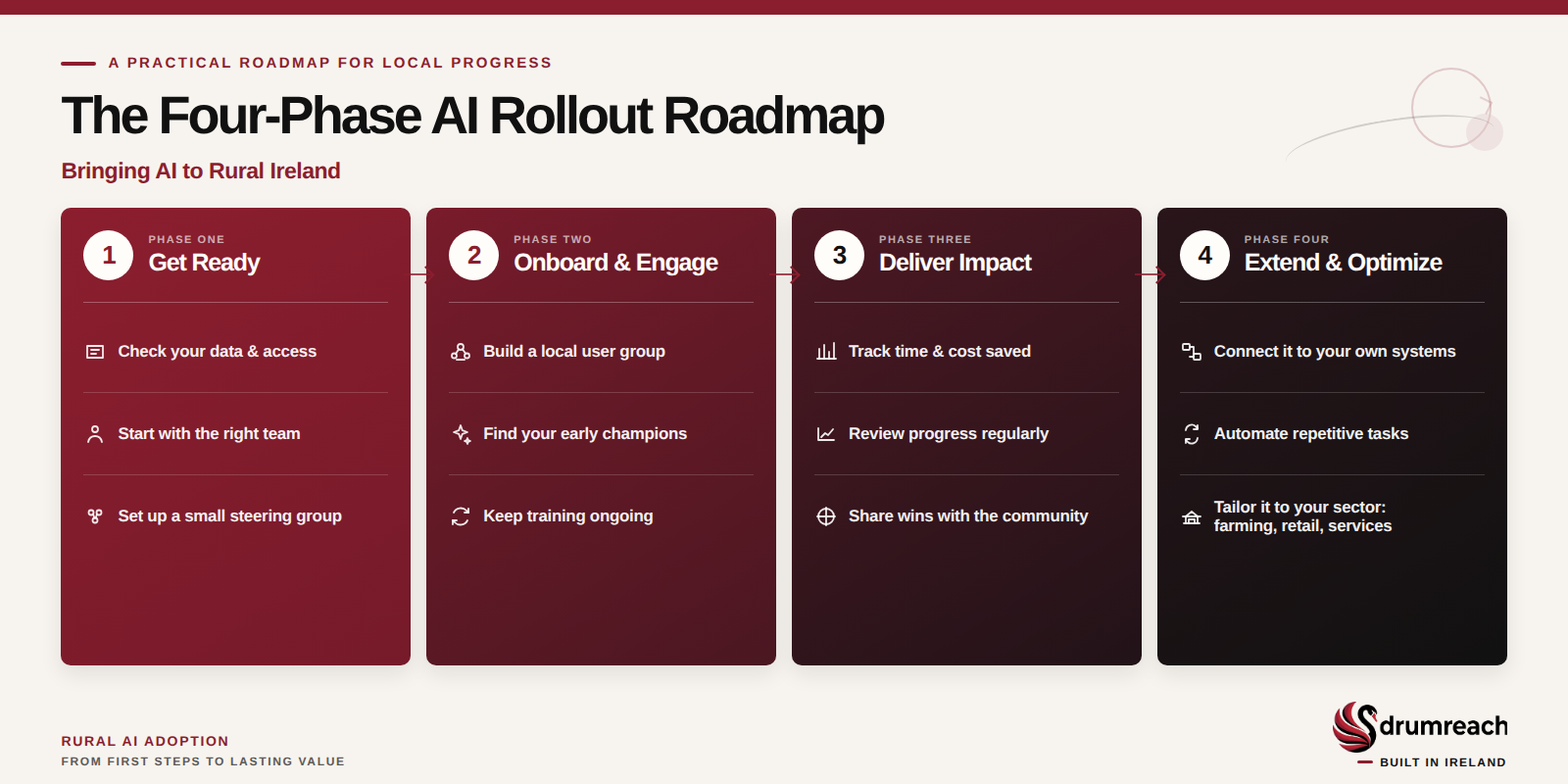
Part 1: The Four-Phase Rollout Roadmap
Think of any AI rollout as four sequential phases, each building on the last.
Phase 1: Get Ready
Before anyone touches the tool, lay the groundwork:
- Audit your data and access controls. Most AI tools inherit existing permissions, so messy access governance becomes messy AI output. Fix data hygiene first.
- Be deliberate about who gets access first. Concentrate initial access in two or three teams with clear use cases rather than spreading it thin across the whole org. Depth beats breadth in the early stages.
- Form a governance group. A small cross-functional team — IT, change management, an executive sponsor, and someone responsible for risk/compliance — should own the rollout and meet regularly.
- Set expectations early. Employees should understand what the tool is good at, what it isn't, and that skepticism is a normal, expected reaction.
Phase 2: Onboard and Engage
This is where you build momentum:
- Create a peer community. A dedicated channel or forum where users share tips, prompts, and wins accelerates learning far faster than top-down training alone.
- Identify and empower champions. Early adopters who are genuinely enthusiastic (not assigned) become your best evangelists. Give them visibility.
- Treat training as ongoing, not a one-time event. Usage habits and skill with the tool evolve over months, not days — build a repeatable training cadence rather than a single launch webinar.
Phase 3: Deliver Impact
Now you prove the value:
- Instrument usage and outcomes. Track adoption metrics (active users, feature usage) alongside outcome metrics (time saved, quality improvements, throughput).
- Keep the governance group meeting. Adoption patterns shift quickly in the first couple of months — regular check-ins let you course-correct before problems compound.
- Celebrate wins publicly. Success stories from real users do more to drive further adoption than any official communication.
Phase 4: Extend and Optimize
Once the foundation is solid, scale deliberately:
- Connect the tool to more of your business systems so it can act on real organizational data, not just generic knowledge.
- Automate specific workflows rather than leaving the tool as a general-purpose assistant.
- Adopt or build role-specific configurations for functions like sales, finance, or service, where a tailored setup delivers more value than a one-size-fits-all deployment.
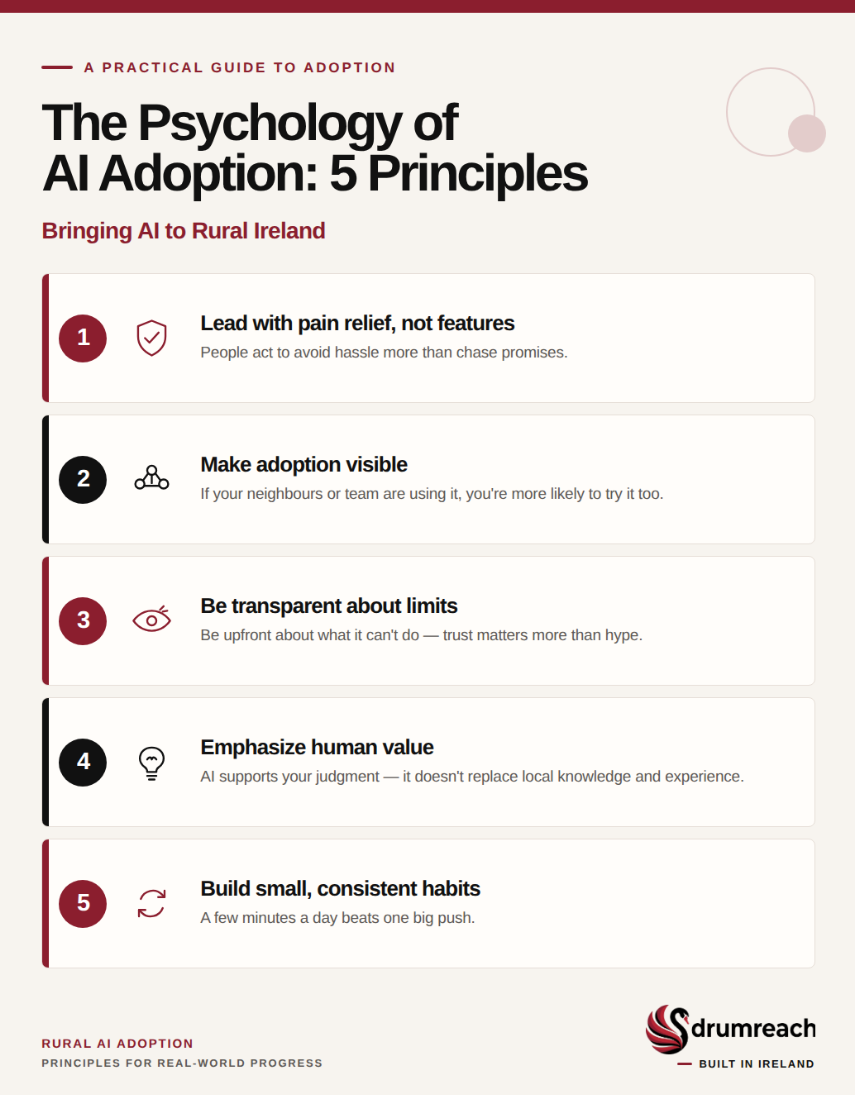
Part 2: The Psychology of Adoption
Structure alone doesn't guarantee people actually use the tool. Behavioral science offers five principles that should shape how you communicate about the rollout at every phase above.
1. Lead with pain relief, not feature lists.
People are more motivated by avoiding losses than by chasing gains. Instead of "this tool will make you more productive," say "this eliminates the two hours a week your team spends on manual reporting." Frame communications around what friction goes away, not abstract value-adds.
2. Make adoption visible.
Behavior is contagious — people are far more likely to try something when they see peers already using it successfully. Publicize usage stats, showcase specific examples of colleagues using the tool, and give leaders a visible role in demonstrating their own usage.
3. Be transparent about capability limits.
Trust needs to match reality. Overselling the tool leads to disappointment and disengagement; underselling it leads to underuse. Clearly explain, in plain language, what the tool does well, how it arrives at its outputs, and where its judgment should be double-checked.
4. Emphasize where humans still add unique value.
People adopt AI more readily when they understand it as augmenting their judgment and expertise, not replacing it. Highlight the human skills — critical thinking, relationship management, creative problem-solving — that remain essential, and give concrete "day in the life" examples of what the new workflow looks like.
5. Build small, consistent habits rather than pushing big behavior change.
People default to familiar routines even when a better option exists. Rather than asking employees to overhaul how they work, set small, specific usage goals ("try it once a day" rather than "use it constantly") and show exactly how it slots into existing workflows. Consistent, low-effort use over weeks is what actually shifts habits.
Putting It Together
The four-phase roadmap tells you when to do what. The five psychological principles tell you how to talk about it at each stage — in your kickoff communications (Phase 1), your training materials and champion messaging (Phase 2), your success story write-ups (Phase 3), and your case for expansion (Phase 4).
Organizations that treat AI adoption purely as a technical rollout tend to see a spike in usage followed by a steady decline. Organizations that pair a clear phased plan with intentional, psychology-aware communication are the ones that turn early curiosity into a lasting change in how people work.
Digital Drumm — Bringing AI to Rural Ireland.